How to Make 3d Pixel Art in Graphicsgale 2018

Pixel fine art, also called Pixel-art or simply Pixelart, is a form of digital fine art, drawn with software, whereby images are built with the exclusive and intentional placement of pixels.
It is widely associated with the low-resolution graphics from 8-bit and 16-bit computers and video game consoles, in addition to other limited systems such every bit graphing calculators, which have a express number of pixels and colors to work with, even if such limitations no longer exist with more recent hardware.
Though the necessity for pixel art has disappeared with the improvement of calculator graphics, the fine art form is still practiced by many pixel artists, and the style is yet mimicked by a significant number of mod video games.[1]
The definition of pixel fine art has been a constant subject area of discussion betwixt artists. In full general, it is characterized by the importance that is placed in each pixel of an image by the artist. Therefore, an image in which the pixels are visible and discernible from i some other, but were non placed with intent or coordination (Such equally in a low resolution photograph) would non be necessarily considered pixel art.
To achieve this minimalist aesthetic, most works of pixel art are as well restrictive in file size and the number of colors used in their color palette, some only using a palette of ii colors (one-bit color depth). Because of this, pixel art presents strong similarities with many traditional fine art forms such as mosaics and sure types of textile techniques (such equally embroidery and knitting), whereby an artwork is produced out of a collection of identical units.[2]
Drawing or modifying pixel fine art characters or objects for video games is sometimes chosen spriting, a term that arose from the hobbyist community. The term likely came from sprite, a concept used in computer graphics to draw a two-dimensional bitmap that is used in tandem with other bitmaps to construct a larger scene.
History [edit]

Origin [edit]
Some traditional art forms, such as counted-thread embroidery (including cross-run up) and some kinds of mosaic and beadwork, are very like to pixel fine art and could exist considered as not-digital counterparts or predecessors. These art forms construct pictures out of modest colored units similar to the pixels of modern digital computing.
Some of the earliest examples of modern pixel art could be found in analog electronic advertisement displays, such as the ones from New York Urban center during the early on 20th century, with elementary monochromatic light bulb matrix displays extant circa 1937.[3] Pixel art every bit it is known today largely originates from classic video games, especially classic arcade games such as Space Invaders (1978) and Pac-Man (1980), and viii-scrap consoles such as the Nintendo Entertainment Organization (1983) and Sega Chief System (1985).
The term pixel art was first published by Adele Goldberg and Robert Flegal of Xerox Palo Alto Research Heart in 1982.[4] The concept, withal, goes dorsum about 11 years earlier that, for instance in Richard Shoup's SuperPaint system in 1972, likewise at Xerox PARC.[5]
In the 1980s, video game creators were mainly programmers and non graphic designers, because this early form had to be manually written past lawmaking pixel by pixel. The limitations of computing at the time and the upkeep assigned to these projects did not allow for an artistic approach, resulting in most of the representations of the time being rather simple (such as Pong, Pac-Man and Space Invaders). Nevertheless, this aesthetic gathered a nifty public appreciation, past which popular culture has been deeply marked.
Gold Age [edit]

The representation of spheres is a well known challenge for pixel-artists, due to the difficulty of making round/spherical objects "read" well (announced clearly to the observer) through a grid of squares. The instance in the sprites above showcases multiple optical illusions and techniques used in order to represent spheres in different lighting atmospheric condition using simply four colors (ii-bit color depth) in a minor canvas. The same principles can be used for larger artworks with larger colour palettes and more than circuitous shapes/images.

This image is non pixel art, but a strict semi-automatic low resolution conversion of the Wikipedia logo to 5 colors (The use of algorithms hither lacks a stylized treat each individual pixel).

This image is pixel fine art, although it used multiple algorithms to recall information from an original render, the stylization in 2 colors was accompanied by a consistent retouching of private pixels - A unmarried standard algorithm would non have been able to represent all the details in this way.
During the 1990s, the widespread availability and accessibility of video games and the advancement in the techniques for pixel manipulation immune for professional graphic designers to specialize in working on figurer graphics. They would work within the limitations of the technology at the time, such as file size and color palettes and largely replaced the "developer art" of the previous decade. These graphic designers tin exist considered 1 of the primeval examples of professional person pixel artists.
New techniques and best practices [edit]
An array of standard techniques and best practices emerged spontaneously with the appearance of these designers, in gild to attain the representation of clear images and characters maximizing their readability despite the minimum resources bachelor on-screen. This includes many optical illusions and clever tricks, such every bit (in no item club):
Visual techniques [edit]
- The careful placement of pixels avoiding jagged edges, informally referred to as "jaggies", in order to better visually signal arcs, circles and curves.
Bend with and without jagged edges
- Using lighter shades of a color in parts of a line to make it appear thinner, or using lighter pixels effectually diagonal lines to counteract the effects of old arcade monitors.
Lighter pixels used to represent a fading line
Lighter pixels used to make diagonal lines appear thicker
- Anti-aliasing drawn by paw, used to soften edges or visually merge clusters of pixels.
An case of anti-aliasing in a curve
An example of anti-aliasing between shapes
- When making a line at an angle (Not direct), at that place'due south a preference for non-jagged pixel lines, which is accomplished by the repetition of a constant array of pixels. For example, a repetition of 1:1 pixels in a diagonal results in a 45° bending line, while a repetition of 1:two pixels in a diagonal results in a 26.57° angle. Anything in between is impossible without jagged lines or requiring anti aliasing. Some video games have used repeated lines of 3 or even 4 pixels for stylization purposes.
1:1 ratio vs 1:two ratio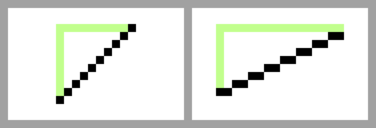
- It is also impossible to achieve the traditional xxx° angle of isometric projection without the appearance of jagged lines, so most pixel games use the 1:2 ratio instead, popularized by titles such every bit Zaxxon and Q*bert equally early as 1982 (followed by a series of seminal titles using the same pseudo-isometric technique since 1983, until its rather systematic adoption in neo-pixel isometric fine art beyond the 2000s and 2010s, generally called for stylization since with college resolution graphics there is no longer any cloth need to maintain this specific ratio nor this precise blazon of "diamond" orientation.
xxx° angle vs 1:2 ratio (26.57° angle)
Other Techniques and Technological Developments [edit]
- Color cycling (Likewise known every bit palette shifting), is a technique used in computer graphics in which colors are changed in gild to give the impression of animation. This technique was mainly used in early on estimator games, equally storing one paradigm and changing its palette required less retentivity and processor power than storing the blitheness as several frames.
- The elaboration of masks, where a specific color lawmaking was defined to be read as transparent, and used in the groundwork of spritesheets (Commonly violet, magenta, red, light-green, blue, or cyan) which was somewhen replaced by the most recent transparency systems that display a dynamic gray checkered "void" in the areas defined as transparent. Some software notwithstanding uses the previous display method, such as Graphics Gale.
- The grouping of image blocks of fixed dimensions in sprite sheets and tile sets (single files that hold multiple assets or iterations), allowing to multiply the background screens and making the workflow easier.
- The adoption of sizes and resolutions divisible past multiples of two (Allowing them to be divided several times in a row in a binary array without whatsoever loss of ratio, post-obit the example of the most widespread display resolutions), such as in the size of character'south pose sprites (being directly fabricated with the sizing in mind or calculation an commencement of blank space), a precaution for better portability and restitution at the reduced display size.
- The employ of sprites of 8x8 or 16x16 pixels (Or any multiple of 8 / power of 2) in size for tiling in guild to salvage calculating time and space while keeping the files organized.
- The choice of lighting orientation (amidst the two opposite diagonals that were already widely used in computer graphics, where the shadow bandage on the lesser right was usually imposed past default, rather than on the bottom left, particularly in texts and their titles or logotypes) with the intention of keeping consistency and improving the readibility of all elements on-screen;
- The development of graphical editors that would allow the edit and import of pixel art graphics into games, and respective game engines that are adjusted to receive these graphics (Such every bit Filmation for the famous pseudo-isometric pixel art fashion)
- The emergence of algorithms and tools meant to accelerate the paradigm editing procedure in full general, such as the accelerated filling tool, circle drawing tool, scaling and configurable deformations of paradigm elements, automatic selections and trimming past tolerance, filter layers, MIP mapping, undo tools, inter-machine compatible software formats (PNG, JPEG), transmission of image colour and resolution, etc.
- A raster interrupt (too called a horizontal blank interrupt) which provides a mechanism for graphics registers to exist changed mid-frame, so they take different values above and below the interrupt bespeak. This allows a single-color object to have multiple, horizontal colour bands, for example, or for a sprite to be repositioned to requite the illusion that at that place are more than sprites than a system supports.
- file size reduction (limited number of colour planes, mirror graphics, retentivity optimized by in-game decompression, distinction between lossy and lossless formats, etc.);
- The settling of conventions for the placement of menus, tools and controls inside graphical editors.
- The specialization within development teams (scriptwriters, designers, programmers, graphic designers, musicians, etc).
When referring to drawing in particular, all of these new technologies permit an creative person to improve approach the issues that naturally arise with pixel art. For instance, If an artist wants to represent the face of a character in a square of less than 10 pixels wide, how many pixels should be used to correspond the mouth, the ears, or the olfactory organ? Should information technology even stand for all of these elements or exit some of them to the viewer's imagination?
Answering these questions for each pixel art project becomes easier every bit applied science develops and as best practices are set, but they still crave an "Artistic" understanding of the medium when placing each pixel.
The placement of each pixel [edit]
Pixel Art has been recognised historically equally the fine art of edifice individual pixels to create an prototype. It is understood that the careful placement is crucial, and fifty-fifty a single pixel out of place can radically shift the viewer'southward perception of an artwork.
Knowing how to place the pixels in the correct place according to the constraints of the medium, while also attempting a realistic or aesthetic representation, is a specialty in its own right.
Because of this, " pixel-pusher " was a common jargon at the time (especially in the international game development scene) used to designate graphics men, gfx men, graphics artists or gfx artists that specialize in pixel fine art. Each pixel was thus "pushed" individually, in a sense (with the cursor and by innumerable round trips with the mouse to the palette, to pick each color separately, for lack of keyboard shortcuts, or even an eyedropper).
As images get bigger in resolution, pixels get harder to distinguish from each other and the importance of their careful placement is diminished, to the betoken that the concept of pixel art falls apart. The exact point at which this occurs and the conditions for a piece to exist reasonably called "pixel art" have been the source of bully disagreement between artists for decades.
The modern palettes [edit]
During the 1980s, brandish systems were more often than not based on a small 8-bit palette of imposed colors (16 stock-still shades innate to each system, oft incompatible from 1 another). The 1990s greatly improved the graphics standard by increasing color depth and basing them on indexed color palettes (For example, 512 colors for the Atari ST and the Mega Bulldoze, 4,096 for the Amiga ECS, 32,768 for the Super Nintendo, and sixteen,777,216 for the Amiga AGA and the VGA fashion of the PCs).
Definition [edit]
Although the definition of the medium is not concrete, the majority of pixel artists agree that an image can be categorized as pixel art when the artist is manipulating the image with deliberate control over the placement of each individual pixel.[1] When purposefully editing in this way, changing the position of a few pixels tin can have a desperate event on the image. Most pixel artists do not consider images that have had filters applied to them which cause the image to look pixellated to be the same equally pixel art, as the pixels that make upwards the image were non consciously placed by the artist, and usually do not agree much importance to the bigger picture.
A common feature in pixel art is the low overall colour count in the epitome. Pixel art as a medium mimics a lot of traits found in older video game graphics, rendered by machines which were capable of only outputting a limited number of colours at once. Additionally, many pixel artists are of the opinion that in well-nigh cases, using a large number of colours, specially when very like to each other in value, is unnecessary, and detracts from the overall cleanliness of the epitome, making information technology look messier. Many experienced pixel artists recommend not using more colours than necessary.
Techniques [edit]

A monster drawn in pixel art

Details from the monster artwork. Left: basic two-color checkerboard dithering. Eye: Stylized dithering with 2×2 pixel squares randomly scattered. Right: Anti-aliasing past manus to smooth curves and transitions.
Drawings normally first with what is called the line art, which is the basis line that defines the character, building or annihilation else the artist is intending to draw. Linearts are usually traced over scanned drawings and are frequently shared among other pixel artists. Other techniques, some resembling painting, also be. In terms of line art, direct lines are easy to accomplish, however, diagonal lines are harder, and curves are harder all the same. Daniel Silber recommends lines of ane pixel in diameter be used at all times.[vi]
The limited palette often implemented in pixel art usually promotes dithering to achieve different shades and colors, but due to the nature of this form of art this is commonly washed completely by mitt, but most software specifically geared toward pixel art offers a dithering option. Encounter the Software section for a list of options. Hand-made anti-aliasing is too used.
Anti-aliasing can be used, past hand, to smooth curves and transitions. Some artists only do this internally, to continue crisp outlines that can go over any background. The PNG alpha channel can be used to create external anti-aliasing for whatsoever groundwork.
Saving and compression [edit]
Pixel art is preferably stored in a file format utilizing lossless data compression, such equally run-length encoding or an indexed color palette. GIF and PNG are two file formats commonly used for storing pixel art. The JPEG format is avoided because its lossy pinch algorithm is designed for smooth continuous-tone images and introduces visible artifacts in the presence of dithering.
-

GIF file
(318 bytes) -

PNG file
(254 bytes) -

Magnified JPEG to show artifacts
-
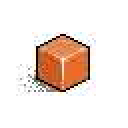
JPEG file
(706 bytes)
Projections [edit]

Isometric

Non-isometric
Pixel art is ordinarily divided in two subcategories: isometric and not-isometric. The isometric kind is drawn in a nearly-isometric dimetric projection. This is ordinarily seen in games to provide a iii-dimensional view without using any existent 3-dimensional processing. Technically, an isometric bending would be of 35.264 degrees from the horizontal, but this is avoided since the pixels created past a line cartoon algorithm would not follow a neat pattern. To fix this, lines with a 1:2 pixel ratio are picked, leading to an angle of about 26.57 degrees (arctan 0.five). One subcategory is planometric, which is done at a 1:1 angle, giving a more height-downwardly wait. Another subcategory is "RPG perspective", in which the x and z (vertical) axes are combined into a side/top view. This view is facing an edge, instead of a vertex.[7]
- Examples of near-isometric pixel art
-

Pixcity (enlarged 4x)
-

PixelPlaza City
Non-isometric pixel art is whatever pixel fine art that does non fall in the isometric category, such equally views from the peak, side, front, bottom or perspective views.
Scaling [edit]
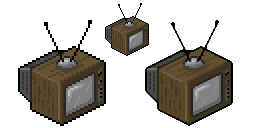
2x zoom interpolated using nearest-neighbor interpolation (left) and the 2xSaI algorithm (right)
When pixel art is displayed at a college resolution than the source image, it is often scaled using the nearest-neighbor interpolation algorithm. This avoids blurring caused by other algorithms, such as bilinear and bicubic interpolation—which interpolate between adjacent pixels and work best on continuous tones, but not sharp edges or lines. Nearest-neighbour interpolation preserves these sharp edges, but it makes diagonal lines and curves look blocky, an effect called pixelation. Thus, hybrid algorithms have been devised to interpolate between continuous tones while preserving the sharpness of lines in the piece; such attempts include the 2xSaI, Super Eagle, and the loftier-quality hqx algorithms.
Uses [edit]
Pixel art was very often used in older computer and console video games.[2] With the increasing use of 3D graphics in games, pixel art lost some of its use. Despite that, it still has a very agile professional/apprentice community. The comeback in current applied science has caused pixel art to evolve, as it allows for ameliorate detail and animation in the fine art way than previously attainable. Pixel art has also been used in advertizement, with one such visitor beingness Bell.[ commendation needed ] The grouping eBoy specializes in isometric pixel graphics for advertising.[viii]
Icons for operating systems with limited graphics abilities are besides pixel art. The limited number of colors and resolution presents a challenge when attempting to convey complicated concepts and ideas in an efficient fashion. On the Microsoft Windows desktop icons are raster images of various sizes, the smaller of which are not necessarily scaled from the larger ones and could be considered pixel art. On the GNOME and KDE desktops, icons are represented primarily by SVG images, but also with hand-optimized, pixel fine art PNGs for smaller sizes such as 16x16 and 24x24. Some other use of pixel art on modern desktop computers is favicons.

Fine art asset from the 2017 video game Flinthook.
Modernistic pixel art has been seen as a reaction to the 3D graphics industry past apprentice game/graphic hobbyists.[nine] Many retro enthusiasts oftentimes cull to mimic the manner of the past. Some view the pixel art revival as restoring the golden historic period of third and quaternary generation consoles, where it is argued graphics were more aesthetically pleasing.[ citation needed ] Pixel art still remains popular and has been used in social networking virtual worlds such as Citypixel and Habbo, too every bit amongst mitt-held devices such as the Nintendo DS, Nintendo 3DS, PSP, PS Vita and mobile phones, and in modern indie games such as Hotline Miami and FTL: Faster Than Lite.[two] Reasons for employing pixel fine art in modernistic video games include that it provokes a feeling of nostalgia for classic video games, it is iconic, it uses smaller file sizes, information technology doesn't require a powerful estimator to be crafted (unlike 3D fine art),it saves fourth dimension when compiling games, information technology works well on small screens similar smartphones, and it remains a popular artful selection.[10]
Software [edit]
Substantially all raster graphics editors tin can be used in some style for pixel art, some of which include features designed to brand the process easier. See comparison of raster graphics editors for a listing of notable ones.
Just notable software primarily designed for pixel fine art is listed here:[11]
| Software | Description | License | Financial toll | Supported platforms | |
|---|---|---|---|---|---|
| Aseprite | Aseprite features a large number of tools for image and animation editing such as layers, frames, tilemaps, command-line interface, Lua scripting, among others. | Proprietary | Gratuitous source code, paid precompiled binaries. | Windows, macOS, Linux | |
| LibreSprite | LibreSprite is a fork of the final free software (libre) version of Aseprite earlier Aseprite became proprietary. | Libre | Gratis | Windows, macOS, Linux | |
| | GrafX2 | GrafX2 was released in 1996, inspired by the Amiga programs Palatial Pigment and Luminescence. Specialized in 256-colour drawing, it includes a very large number of tools and furnishings suitable for pixel art and second video game graphics.[12] | Libre | Gratis | AmigaOS, Android, Atari MiNT, FreeBSD, Genode, Haiku, IRIX, Linux, macOS, Windows, MorphOS, MS-DOS, Syllable Desktop |
| Pro Motion NG | Pro Motion NG is primarily geared towards drawing fine art for video games, with features and tools for blitheness, spritework, and tilesets. | Proprietary | Paid (Full Edition), gratis (Complimentary Edition) | Windows, macOS, Linux | |
| Graphics Gale | Graphics Gale is a Japanese pixel art editor with animation features and a color-based transparency system which was extensively used by game artists during its early years.[ commendation needed ] It was written in 2005, made freeware in 2017, and last updated in 2018. | Proprietary | Gratis | Windows | |
| PyxelEdit | PyxelEdit has features for working with tiles and tilesets. | Proprietary | Paid (current version), gratis (quondam beta 0.two.22c) | Windows, macOS, Linux | |
| Piskel | Piskel was designed to be relatively simple and easy to use. | Libre | Gratis | Web | |
| | PixiEditor | PixiEditor has a graphical user interface layout designed to be similar to other raster graphics editors, such as GIMP, with the intention of making it a convenient plan for digital artists who wish to acquire pixel art.[thirteen] It is relatively lightweight in file size when compared to other tools such every bit GIMP. | Libre | Gratis | Windows |
| Lospec Pixel Editor | Lospec Pixel Editor was designed for beginner pixel artists. It integrates with many of Lospec's features, such equally the Lospec Palette List. | Proprietary | Gratis | Web | |
| Pixilart | Pixilart has many features, and allows users to share their art. | Libre | Gratis | Web | |


Groups and Communities [edit]
Because of the nature of pixel art as a specialization from digital fine art, the associations to a detail era and the ways of the game industry, professional pixel artists used to be really hard to come up by. This made manner to the germination of multiple groups and small-scale communities dedicated to curate and organize pixel artists, some of which notwithstanding stand active today. These communities have played a large office in keeping the medium live and introducing the concept to new artists, since they have guided many artists to specialize in pixel-art (providing tools and a place for feedback/criticism), and encouraged many developers to choose the medium through the boom of indie games in contempo years.
Only notable forums and communities are listed here:[11]
| Community | Description | Category | Relevant Features | Active since | |
|---|---|---|---|---|---|
| | Pixeljoint | PixelJoint is one of the oldest pixel art websites still agile. It was released to the public on December seven, 2004. Since the site has opened to submissions the gallery has grown steadily, a forum was opened and a couple of collaborative projects began. | Website | Gallery, Competitions, articles, interviews and tutorials. | 2004 |
| | Lospec | Lospec was created to part equally a compilation of tools and resources for pixel artists. Over time, the website has expanded into other more than traditional community functions, such as a gallery, a public forum and the creation of their ain tools and tutorials. | Website | Gallery, articles, tool development, resources and tutorials. | 2017 |
| Pixelation | Forum powered by SMF | Forum | |||


Run across besides [edit]
- ASCII art
- Cel shading
- Cross-stitch
- Low poly
- Mosaic
- Place (Reddit)
References [edit]
- ^ a b Silber, Daniel. Pixel Art for Game Developers. CRC Press, 2017. Retrieved April fifteen, 2019
- ^ a b c Podgorski, Daniel (September 30, 2015). "Style past Necessity: FTL: Faster Than Light, and Pixel Art as a New Cubism". The Gemsbok . Retrieved March 24, 2016.
- ^ New York in the mid 1930s in Colour. Rick88888888. iii August 2019. Event occurs at 23:49-23:55 – via Youtube.
- ^ Goldberg, Adele and Robert Flegal. "ACM president's letter: Pixel Art". Communications of the ACM. Vol. 25. Issue 12. Dec. 1982.
- ^ T. Due south. Perry and P. Wallich, "Inside the PARC: the `information architects'," in IEEE Spectrum, vol. 22, no. x, pp. 62-76, Oct. 1985.
- ^ Silber, Daniel (2016). Pixel art for game developers. Boca Raton: CRC Press. pp. 23–27. ISBN9781482252316.
- ^ Razorback, Fil. "Chapter iii: Perspectives". OpenGameArt.org. Les Forges Pixel Art Course. Retrieved March 24, 2016.
- ^ Eskilson, Stephen J. (2012-02-28). Graphic Design: A New History (2 ed.). p. 392. ISBN978-0300172607.
- ^ Chierchia, WDfriday, Francis Chouquet, Matthieu Bué, Nicolas Lussagnet, Ange. "Démystifions le Pixel Art : interview d'Olivier Huard » Webdesign Friday (#wdfr)".
- ^ Silber, Daniel (2016). Pixel art for game developers. Boca Raton: CRC Press. pp. i–eight. ISBN9781482252316.
- ^ a b "Pixel Art Software List". lospec.com . Retrieved 2022-01-30 .
- ^ "GrafX2 - The ultimate 256-color painting plan". grafx2.chez.com . Retrieved 2022-01-30 .
- ^ "Master page | PixiEditor". pixieditor.net . Retrieved 2022-02-02 .
Familiar interface: Have you ever used Photoshop or Gimp? Reinventing the wheel is unnecessary, we wanted users to get familiar with the tool quickly and with ease.
Further reading [edit]
- Silber, Daniel (2016). Pixel art for game developers. Boca Raton: CRC Press. ISBN9781482252316.
Source: https://en.wikipedia.org/wiki/Pixel_art
0 Response to "How to Make 3d Pixel Art in Graphicsgale 2018"
Post a Comment