If People Can Be Prevented From Using a Certain Good, Then That Good Is Called
Defining a Expert
At that place are 4 types of goods in economics, which are defined based on excludability and rivalrousness in consumption.
Learning Objectives
Define a good
Key Takeaways
Cardinal Points
- Individual appurtenances are excludable and rival. Examples of private goods include food and clothes.
- Common goods are not-excludable and rival. A classic example is fish stocks in international waters.
- Club goods are excludable only non-rival. Cablevision tv is an example.
- Public goods are not-excludable and not-rival. They include public parks and the air nosotros breathe.
Key Terms
- Rival: A good whose consumption past 1 consumer prevents simultaneous consumption by other consumers
- Excludable: A expert for which it is possible to forestall consumers who have not paid for it from having access to information technology.
At that place are four categories of goods in economic science, which are divers based on 2 attributes. The first attribute is excludability, or whether people tin can be prevented from using the good. The 2nd is whether a good is rival in consumption: whether i person'south use of the adept reduces some other person's ability to utilize it.
National defense provides an case of a good that is not-excludable. America's national defense establishment offers protection to everyone in the country. Items on sale in a shop, on the other hand, are excludable. The store possessor tin prevent a customer from obtaining a good unless the client pays for information technology. National defence besides provides an example of a good that is non- rivalrous. One person'due south protection does not preclude another person from receiving protection. In contrast, shoes are rivalrous. Only ane person can wear a pair of shoes at a time.
Combinations of these two attributes create 4 categories of goods:

4 Types of Goods: There are four categories of goods in economic science, based on whether the appurtenances are excludable and/or rivalrous in consumption.
- Private goods: Individual goods are excludable and rival. Examples of individual goods include food, wearing apparel, and flowers. There are usually limited quantities of these goods, and owners or sellers can prevent other individuals from enjoying their benefits. Because of their relative scarcity, many private goods are exchanged for payment.
- Common appurtenances: Common goods are not-excludable and rival. Because of these traits, mutual goods are easily over-consumed, leading to a miracle called "tragedy of the commons. " In this state of affairs, people withdraw resources to secure short-term gains without regard for the long-term consequences. A classic example of a common good are fish stocks in international waters. No 1 is excluded from fishing, but as people withdraw fish without limits being imposed, the stocks for afterward fishermen are depleted.
- Order goods: Lodge goods are excludable but non-rival. This type of good often requires a "membership" payment in order to enjoy the benefits of the goods. Not-payers can exist prevented from access to the goods. Cable television is a archetype example. It requires a monthly fee, only is non-rival after the payment.
- Public goods: Public goods are non-excludable and not-rival. Individuals cannot be effectively excluded from using them, and utilize past one individual does not reduce the good's availability to others. Examples of public goods include the air nosotros exhale, public parks, and street lights. Public appurtenances may give ascension to the "gratis rider problem. " A free-passenger is a person who receives the benefit of a good without paying for it. This may lead to the nether-provision of certain goods or services.
Individual Goods
A individual good is both excludable and rivalrous.
Learning Objectives
Ascertain a private good
Key Takeaways
Fundamental Points
- The owners or sellers of individual goods exercise private property rights over them.
- A consumer generally has to pay for a private good.
- Mostly, the marketplace volition efficiently classify resources for the production of private goods.
Fundamental Terms
- Excludable: A skilful for which it is possible to prevent consumers who have not paid for it from having access to it.
- Rivalrous: A good whose consumption by 1 consumer prevents simultaneous consumption by other consumers.
In economic science, a private good is defined as an nugget that is both excludable and rivalrous. Information technology is excludable in that it is possible to exercise private property rights over it, preventing those who accept non paid from using the proficient or consuming its benefits. For example, person A may have the means and volition to pay $twenty for a t-shirt. Person B may non wish to pay $xx or may not be able to practise so. Person B would not be able to purchase the t-shirt. Additionally, the individual skilful is rivalrous in that its consumption past one person necessarily prevents consumption by another. When person A purchases and drinks a bottle of water, the same canteen of h2o is not available for person B to buy and eat.
A private good is a scare economic resource, which causes competition for it. Generally, people have to pay to relish the benefits of a private good. Because people have to pay to obtain information technology, private goods are much less probable to run into a complimentary-rider problem than public goods. Thus, generally, the marketplace will efficiently classify resources to produce private goods.
In daily life, examples of individual goods abound, including nutrient, clothing, and virtually other goods that can exist purchased in a store. Have an example of an ice cream cone. It is both excludable and rivalrous. It is possible to prevent someone from consuming the water ice cream past simply refusing to sell it to them. Additionally, it tin can be consumed but one time, so its consumption by i private would definitely reduce others' ability to eat information technology.

Ice Cream Cone: An ice foam cone is an example of a private good. Information technology is excludable and rival.
Public Goods
Individuals cannot exist excluded from using a public good, and one private'south utilize of it does not limit its availability to others.
Learning Objectives
Ascertain a public good
Cardinal Takeaways
Fundamental Points
- A public proficient is both non-excludable and non-rivalrous.
- Pure public appurtenances are perfectly non-rival in consumption and non-excludable. Impure public goods satisfy those weather condition to some extent, merely not perfectly.
- Public goods provide an example of market place failure. Considering of the free-rider trouble, they may be underpoduced.
Primal Terms
- free passenger: Someone who enjoys the benefits of a good without paying for information technology
- Non-excludable: Non-paying consumers cannot be prevented from accessing a skilful
- Non-rivalrous: A skillful whose consumption past one consumer does not preclude simultaneous consumption by other consumers
A public good is a good that is both non-excludable and non-rivalrous. This means that individuals cannot exist finer excluded from its employ, and use by i individual does non reduce its availability to others. Examples of public goods include fresh air, knowledge, lighthouses, national defense, flood control systems, and street lighting.

Streetlight: A streetlight is an example of a public skillful. It is non-excludable and non-rival in consumption.
Public goods can be pure or impure. Pure public appurtenances are those that are perfectly non-rivalrous in consumption and not-excludable. Impure public goods are those that satisfy the ii conditions to some extent, but not fully.
The production of public goods results in positive externalities for which producers don't receive full payment. Consumers tin take advantage of public goods without paying for them. This is chosen the "free-rider trouble. " If too many consumers make up one's mind to "free-ride," private costs to producers will exceed individual benefits, and the incentive to provide the practiced or service through the marketplace will disappear. The market will thus neglect to provide enough of the good or service for which at that place is a need.
For case, a local public radio station relies on support from listeners to operate. The station holds pledge drives several times a year, asking listeners to brand contributions or face up possible reduction in programming. Still only a small percentage of the audience makes contributions. Some audition members may even listen to the station for years without ever making a payment. Those listeners who do not make a contribution are "gratuitous-riders. " If the station relies solely on funds contributed by listeners, it would under-produce programming. It must obtain additional funding from other sources (such as the government) in order to continue to operate.
Optimal Quantity of a Public Expert
The authorities is providing an efficient quantity of a public good when its marginal benefit equals its marginal cost.
Learning Objectives
Explicate the optimal quantity of a public good
Fundamental Takeaways
Primal Points
- Collective demand for a public good is the vertical summation of individual demand curves. It shows the cost society is willing to pay for a given quantity of a public skillful.
- The demand bend for a public expert is downwardly sloping, due to the law of diminishing marginal utility. The supply curve is upward sloping, due to the law of diminishing returns.
- The optimal quantity of a public practiced occurs where the need ( marginal benefit ) curve intersects the supply ( marginal cost ) curve.
- The authorities uses cost-benefit analysis to decide whether to provide a particular good. If MB is greater than MC there is an underallocation of a public good. If MC is greater than MB there is an overallocation of a public good. When MC = MB then there is an optimal allocation of public goods.
Primal Terms
- Cost-benefit analysis: A systematic process for computing and comparing the marginal benefits and marginal costs of a project or action.
To determine the optimal quantity of a public good, it is necessary to first determine the demand for it. Demand for public goods is represented through price-quantity schedules, which evidence the toll someone is willing to pay for the extra unit of each possible quantity. Unlike the market place need curve for private goods, where individual demand curves are summed horizontally, individual demand curves for public goods are summed vertically to become the market demand bend. As a upshot, the market demand curve for public goods gives the price social club is willing to pay for a given quantity. It is equal to the marginal benefit bend. Due to the law of diminishing marginal utility, the demand curve is downward sloping.
Ofttimes, the government supplies the public good. The supply curve for a public good is equal to its marginal cost bend. Because of the law of diminishing returns, the marginal cost increases as the quantity of the good produced increases. The supply curve therefore has an upward slope.
As already noted, the demand curve is equal to the marginal benefit curve, while the supply bend is equal to the marginal cost bend. The optimal quantity of the public practiced occurs where MB (society's marginal benefit) equals MC (provider's marginal cost), or where the two curves intersect. When MB = MC, resources have been allocated efficiently.

Optimal Quantity of a Public Expert: The optimal quantity of public practiced occurs where MB = MC.
The public proficient provider uses price-benefit analysis to decide whether to provide a particular adept past comparing marginal costs and marginal benefits. Price-do good analysis can also assist the provider make up one's mind the extent to which a projection should be pursued. Output activity should be increased as long as the marginal benefit exceeds the marginal cost. An activity should not be pursued when the marginal do good is less than the marginal price. An activity should be stopped at the point where MB equals MC. This is the MC=MB rule, past which the provider of the public proficient can determine which plan, volition requite lodge maximum net benefit.
Demand for Public Goods
The aggregate demand curve for a public good is the vertical summation of private demand curves.
Learning Objectives
Analyze the need for a public good.
Key Takeaways
Primal Points
- For public appurtenances, aggregate demand is the sum of marginal benefits to each person at each quantity of the good provided.
- Every bit for individual goods, the individual demand curves evidence the cost someone is willing to pay for an extra unit of measurement of each possible quantity of a good.
- The efficient quantity of a public skillful is the quantity at which marginal benefit equals marginal toll.
- The efficient quantity of a public good is the quantity at which marginal benefit equals marginal cost.
Key Terms
- public good: A adept that is non-rivalrous and not-excludable.
The aggregate demand for a public proficient is derived differently from the aggregate demand for private goods.
To an individual consumer, the total benefit of a public practiced is the dollar value that he or she places on a given level of provision of the proficient. The marginal benefit for an individual is the increase in the total benefit that results from a ane-unit increase in the quantity provided. The marginal benefit of a public good diminishes every bit the level of the skilful provided increases.
Public goods are non-rivalrous, and then everyone can consume each unit of a public good. They also take a stock-still market place quantity: anybody in society must agree on consuming the same amount of the skilful. Still, each individual'south willingness to pay for the quantity provided may exist different. The individual need curves bear witness the price someone is willing to pay for an extra unit of each possible quantity of the public good.
The amass need for a public good is the sum of marginal benefits to each person at each quantity of the skilful provided. The economic system'southward marginal benefit curve (demand curve) for a public skillful is thus the vertical sum all private's marginal benefit curves. The vertical summation of individual demand curves for public goods as well gives the amass willingness to pay for a given quantity of the good.

Demand for a Public Good: The sum of the individual marginal benefit curves (MB) represent the amass willingness to pay or aggregate demand (∑MB). The intersection of the aggregate need and the marginal cost curve (MC) determines the amount of the good provided.
This is in contrast to the aggregate demand bend for a private good, which is the horizontal sum of the individual need curves at each price. Dissimilar public goods, society does not take to concur on a given quantity of a private good, and any one person tin consume more than of the private practiced than another at a given price.
The efficient quantity of a public proficient is the quantity that maximizes net benefit (total benefit minus full cost), which is the aforementioned as the quantity at which marginal benefit equals marginal cost.
Cost-Benefit Analysis
The regime uses toll-do good analysis to decide whether to provide a public proficient.
Learning Objectives
Explain how to determine the net toll/do good of providing a public proficient
Central Takeaways
Key Points
- Cost -benefit analysis is a systematic way of calculating the costs and benefits of a project to club equally a whole.
- Benefits and costs are expressed in monetary terms and are adjusted for the time-value of money.
- Financial costs are much easier to capture in the analysis than not-financial welfare impacts, such every bit impacts on human life or the environs.
- The government should provide a public expert if the benefits to society outweigh the costs.
Primal Terms
- cyberspace present value: The present value of a projection determined past summing the discounted incoming and outgoing time to come greenbacks flows resulting from the decision.
The government uses cost-benefit assay to decide whether to provide a particular public good and how much of it to provide. Cost-benefit analysis, which is likewise sometimes chosen do good-toll analysis, is a systematic procedure for computing the benefits and costs of a projection to social club as a whole.
The positive and negative effects captured by cost-benefit analysis may include effects on consumers, furnishings on non-consumers, externality effects, or other social benefits or costs. The guiding principle is to listing all parties affected by a project and add a negative or positive value that they accredit to the project's effect on their welfare. Benefits and costs are expressed in budgetary terms, and are adjusted for the time value of money, so that all flows of benefits and costs over time are expressed on a mutual basis in terms of their internet present value. Financial costs tend to be most thoroughly represented in cost-benefit analyses due to relatively abundant marketplace data. It is much more difficult to capture non-financial welfare impacts. For example, it is very difficult to place a dollar value on human life, consumers' time, or environmental impact.
Imagine that the government is considering a project to widen a highway. The benefits side of the analysis might include time savings for passengers who can now avoid traffic, an increase in the number of passenger trips (every bit more people could now apply the road), and lives saved by dint of fewer motorcar accidents. The cost side of the analysis would include the cost of land that must be acquired prior to construction, construction, and maintenance. These costs and benefits will demand to be translated into monetary terms for the sake of analysis.
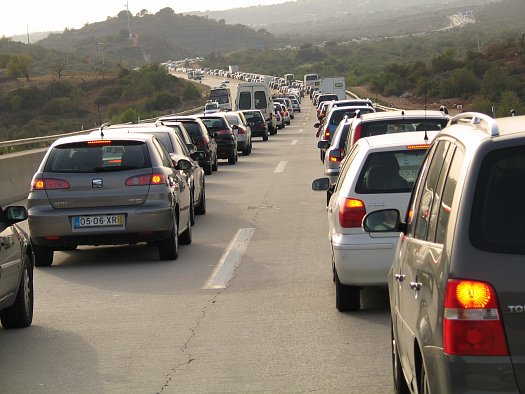
The Highway as a Public Good: The benefits of a highway expansion project might include fourth dimension savings for passengers, boosted passenger trips, and saved lives. Costs might include construction and maintenance.
The process for conducting toll-do good analysis is every bit follows:
- Identify project(s) to be analyzed.
- Judge all costs and benefits to society associated with the project(s) over a relevant time horizon.
- Assign a monetary value to all costs and benefits.
- Calculate the net benefit of the project (total benefit minus total cost).
- Adapt for inflation and employ the disbelieve charge per unit to calculate nowadays value of the project.
- Summate the internet present value for the project(due south).
- Make recommendation almost projection(s). If the benefit outweighs the cost, then the government should proceed with the project.
Source: https://courses.lumenlearning.com/boundless-economics/chapter/public-goods/
0 Response to "If People Can Be Prevented From Using a Certain Good, Then That Good Is Called"
Post a Comment